Case Management System for Arbitration & Mediation Centers
Digital Transformation in Arbitration Centers
In international arbitration centers, digital infrastructure is no longer optional; it has become a fundamental requirement. Leading institutions now run every stage through a Case Management System.
For institutions still depending on manual operations, transformation is not a preference anymore—it is an inevitable next step.


Global Standard: Arbitration Management with Case Management System
Leading arbitration centers worldwide manage all processes through a digital Case Management System. Each phase of arbitration is tracked, validated, and secured for operational excellence.
Digital Application Process
Online application forms, role assignments for parties / arbitrators / secretariat, and instant notifications start every file digitally from day one.
Automated Process Management
Deadline tracking and automatic reminders keep each case moving without missing critical milestones.
Security and Transparency
Audit trails, identity verification, e-signature integrations, and central archiving provide full trust and control.
The Cost of Traditional Methods
Many centers still process applications by email, store files in folders, follow deadlines in spreadsheets, and send manual notifications. This routine creates structural risk in both daily operations and long-term governance.
During staff changes, information transfer slows down, the latest document versions become unclear, and institutional auditability weakens.

Analytec Case Management System: Phased and Flexible Digitalization
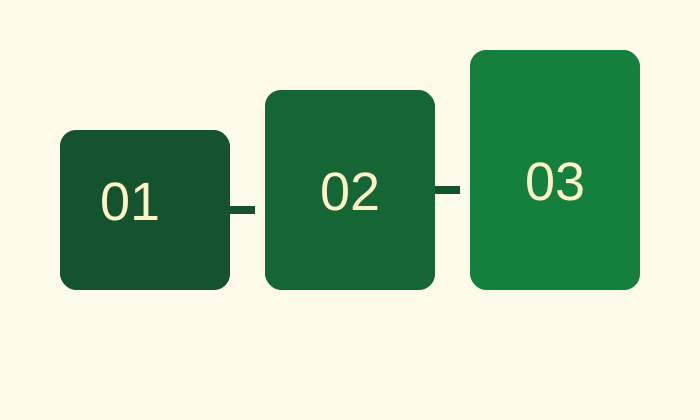
Analytec offers a modular structure so institutions can digitalize at their own pace, replacing high-risk “change everything at once” implementations.
Stage 01
Application Digitalization
Implement online application to reduce email traffic and standardize case opening.
Stage 02
Document Management
Add a central repository, version control, and secure sharing as the operational core.
Stage 03
Process Automation
Complete transformation with automated notifications, deadline tracking, and workflow management.
Three-Tier System: Choose According to Your Needs
Institutions can start with a basic tier and scale up over time based on operational maturity and budget priorities.
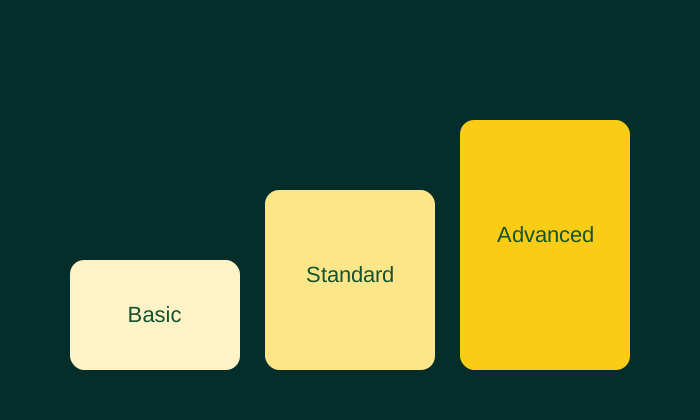
Basic Tier System
- Digital application system
- Secretariat panel
- Basic document management
Standard Tier System
- All features of the basic tier system
- Party panel
- Arbitrator panel
- Users can track and perform actions from their own panels
Advanced Tier System
- All features of the standard tier system
- Additional user panels such as expert panel
- AI-powered document categorization
- AI assistant for users' own data (transaction tracking, Q&A)
Distinguishing Features of the Analytec Case Management System
Secretariat-Focused Design
Unlike IT-centric global products, Analytec is designed to reduce daily secretariat workload with practical operations support.
- Task assignment
- Automatic reminders
- Step checklists
- Timeline view
Data Security and GDPR Compliance
Client-server deployment, private installation options, and GDPR-compliant architecture keep data entirely under your control.
- On-premise option
- Private deployment
- GDPR alignment
- No overseas-server dependency
Practical AI Usage
AI features are built for measurable work outcomes, not just presentation value.
- OCR
- Smart search
- Automatic classification
- Actionable, workflow-ready AI

The Next Step in Digital Transformation
For arbitration institutions that want to stand out in global competition, digital infrastructure is now a strategic necessity.
- Increase operational efficiency
- Minimize error rates
- Preserve institutional memory
- Maximize transparency and security
- Gain a competitive advantage
Start your phased digitization today, see the difference tomorrow.
Referans Görseller